


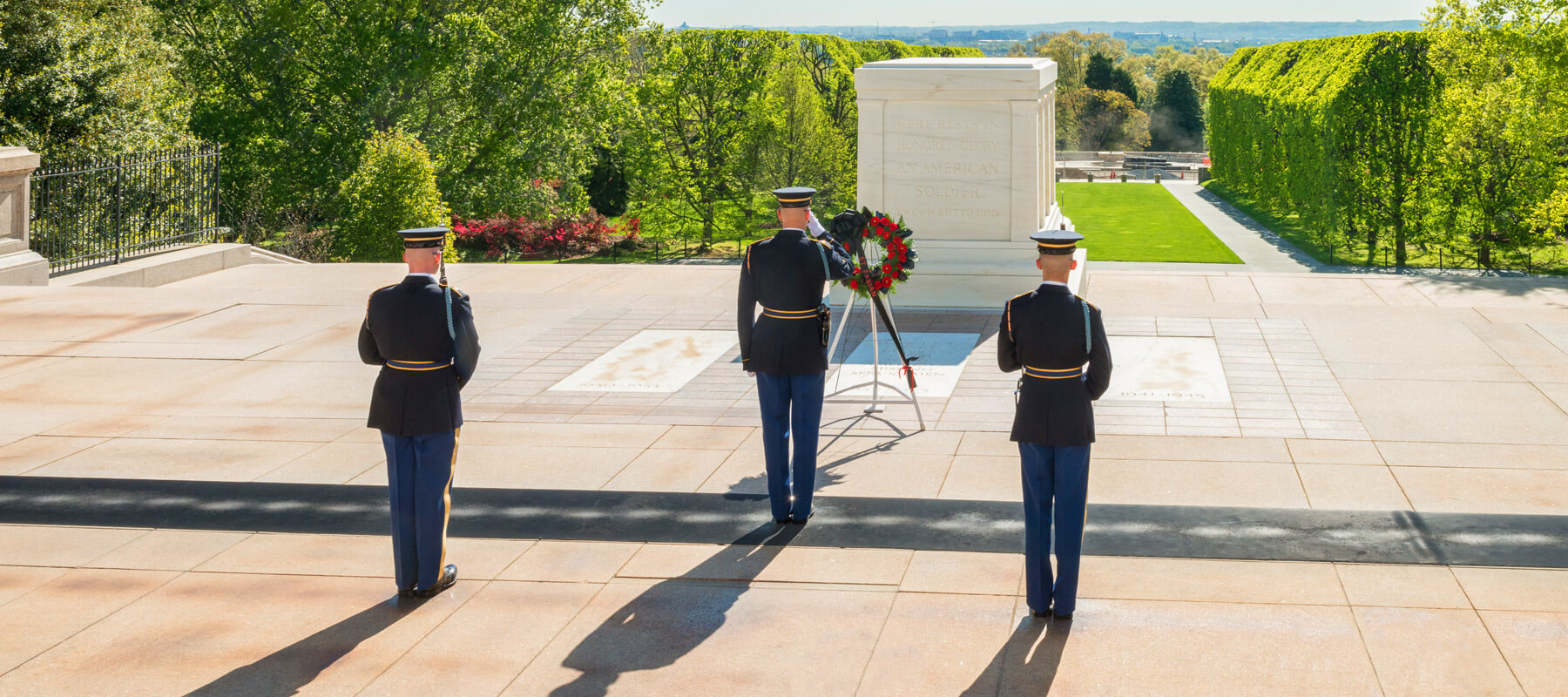
Learn about the Tomb of the Unknown Soldier
-
What Is the Tomb of the Unknown Soldier?
Arlington National Cemetery is a place of quiet reflection and honor. It covers hundreds of acres overlooking Washington, D.C., and serves as the final resting place for more than 400,000 service members and their families. In the center of these grounds stands the Tomb of the Unknown Soldier, a monument built to honor American soldiers whose names and identities are lost to war.
The tomb represents every service member who made the ultimate sacrifice without recognition. It has become one of the most visited and meaningful sites in Arlington National Cemetery. The sight of a guard walking with measured steps, protecting the tomb day and night, reminds visitors of the respect owed to all who have served. Every detail, from the marble carvings to the constant watch, tells a story of courage, loss, and national gratitude.
What Are the Origins of the Tomb of the Unknown Soldier?
The Tomb of the Unknown Soldier began as an idea after World War I. Thousands of American soldiers were buried overseas without names, leaving families with no way to know where their loved ones rested. In 1921, Congress approved the creation of a tomb to honor one of these unidentified heroes. Sergeant Edward F. Younger, a decorated soldier, was chosen to select the Unknown. He placed a single white rose on one casket among four, and that casket was brought home to Arlington National Cemetery. On November 11, 1921, now known as Veterans Day, the Unknown Soldier was laid to rest during a ceremony attended by President Warren G. Harding and thousands of citizens.
Later, new crypts were added for unidentified soldiers from other wars. In 1956, President Dwight D. Eisenhower signed a bill to include Unknowns from World War II and the Korean War. Their remains were buried at Arlington National Cemetery two years later. A third crypt was added for a soldier from the Vietnam War in 1984. However, those remains were identified through DNA testing in 1998, and the tomb now bears an inscription honoring all missing service members from that conflict. Each crypt stands as a lasting promise that every fallen service member, known or unknown, will be remembered.
What Does the Tomb of the Unknown Soldier Represent?
The design of the Tomb of the Unknown Soldier is simple but filled with meaning. The large marble structure, known as the sarcophagus, was completed in 1931. It was built from bright white marble taken from Vermont, symbolizing purity and peace. The front shows three carved figures — Peace, Valor, and Victory — each representing an ideal that American soldiers have defended throughout history. Between these figures are six wreaths carved in relief, each representing a major battle fought in World War I.
Behind the main tomb are three smaller marble crypts. These mark the resting places of the Unknown Soldiers from World War II and Korea, and the empty crypt that once held the remains of the Vietnam Unknown. The layout is designed to invite quiet reflection. When you stand before the tomb, you can see the open lawns of Arlington National Cemetery stretching out in every direction. The view creates a feeling of connection between the living and those who gave their lives in service.
Every part of the tomb’s design reflects the values it honors such as sacrifice, unity, and remembrance. Visitors who come to Arlington National Cemetery often speak of the peace they feel standing before it. The stillness, the watchful guards, and the enduring message of respect all remind us that freedom has a cost, and that cost is never forgotten.
Who Guards the Tomb of the Unknown Soldier?
The Tomb of the Unknown Soldier is watched over every hour of every day, through heat, rain, and snow. The honor of guarding it belongs to the 3rd U.S. Infantry Regiment, known as The Old Guard, the oldest active-duty infantry unit in the Army. They are responsible not only for protecting the tomb but also for performing military funerals, ceremonies, and other duties across Arlington National Cemetery.
Each guard, known as a Sentinel, carries out a duty that requires absolute precision and discipline. Training to become a Sentinel takes months of preparation, involving uniform inspections, physical conditioning, and detailed study of the tomb’s history and meaning. Every movement, from the placement of their steps to the turn of their head, follows a strict standard of excellence. The Sentinel’s Creed ends with the words, “My standard will remain perfection,” which defines the pride and respect they bring to this sacred duty.
Sentinels never wear rank insignia on their uniforms. This ensures that no guard ever appears to outrank the soldiers resting within the tomb. The Tomb of the Unknown Soldier honors all unidentified service members, and the Sentinels’ uniform reflects humility and equality before those who gave their lives.
The guards follow a precise pattern of 21 steps across a black mat in front of the tomb, pause for 21 seconds, then repeat the motion. The number 21 represents the 21-gun salute, the highest military tribute. This ritual has been carried out continuously since 1948, marking one of the longest-running ceremonial watches in the world.
Visitors at Arlington National Cemetery can witness this moving tradition during the Changing of the Guard ceremony. One Sentinel relieves another through a sequence of slow, deliberate movements. The click of their shoes, the sound of the rifle inspection, and the quiet that fills the crowd make it one of the most powerful experiences in Washington, D.C. The ceremony takes place every half hour in summer and every hour in winter. Guests are asked to remain silent and standing as a sign of respect for the service members represented by the tomb.
How Can You Visit the Tomb of the Unknown Soldier?
Visiting the Tomb of the Unknown Soldier is one of the most meaningful experiences at Arlington National Cemetery. The cemetery is open daily, and the best way to get there is by taking the Metrorail Blue Line to the Arlington Cemetery stop. Many visitors also enjoy walking across the Arlington Memorial Bridge from the Lincoln Memorial, a route that offers sweeping views of the cemetery’s white headstones and green hills. Personal vehicles are not allowed inside, but Arlington National Cemetery Tours provides narrated trolleys that stop at the most significant landmarks, including the Tomb of the Unknown Soldier.
Most visitors spend two to three hours exploring the grounds. The Kennedy gravesite, home to the eternal flame honoring President John F. Kennedy, is among the most visited stops. Arlington House, once the home of Robert E. Lee, is open for tours and helps tell the story of how the estate became Arlington National Cemetery. Near the tomb stands the Memorial Amphitheater, which serves as the setting for official state ceremonies and military events, including Memorial Day and Veterans Day observances.
Beyond these landmarks, the cemetery holds the graves of national figures such as Supreme Court Justice Thurgood Marshall, World War II hero Audie Murphy, and the astronauts of the Space Shuttle Challenger. Each site adds to the collective story of service and sacrifice that defines Arlington National Cemetery.
Spring and fall are ideal times to visit, when the weather is pleasant and the trees frame the monuments in color. During these seasons, the grounds offer a quiet beauty that matches the solemn purpose of the place. Whether you come to watch the Changing of the Guard, explore the grounds, or simply reflect in silence, your visit to the Tomb of the Unknown Soldier will leave a lasting impression of respect and gratitude.
Why Does the Tomb of the Unknown Soldier Remain So Important?
The Tomb of the Unknown Soldier continues to hold a central place in the nation’s heart because it speaks to the idea that every life given in service deserves to be remembered. It represents all service members whose names or identities were lost to war, yet whose bravery remains part of our shared history.
Visitors to Arlington National Cemetery often describe a feeling of deep silence when they reach the tomb. The space commands quiet not through rules but through presence. The marble structure, the steady steps of the Sentinel, and the surrounding view of endless white headstones create a powerful reminder of sacrifice. This is not a place for noise or distraction; it is a space for gratitude and reflection.
The Tomb of the Unknown Soldier endures because it continues to remind every visitor of the cost of freedom. It encourages reflection on the individuals who stood for their country, even when their names are unknown. It is both a historical landmark and a continuing commitment to honor those who cannot speak for themselves.
FAQs
Q1. Where is the Tomb of the Unknown Soldier located in Arlington National Cemetery?
The Tomb of the Unknown Soldier sits near the center of Arlington National Cemetery beside the Memorial Amphitheater. The location was chosen for its prominence and peaceful elevation overlooking Washington, D.C. The site provides visitors with a wide view of the surrounding hills, the Potomac River, and the city beyond. The tomb is part of the main route followed by all guided tours of Arlington National Cemetery, ensuring that every visitor can see it. The Memorial Amphitheater nearby serves as the site of national ceremonies, making this area the symbolic heart of the cemetery.
Q2. How long does the Changing of the Guard ceremony last at the Tomb of the Unknown Soldier?
The Changing of the Guard ceremony at the Tomb of the Unknown Soldier lasts about 15 minutes. This ceremony represents one of the highest honors in the United States military. During the ceremony, one Sentinel is relieved by another in a series of precise movements. The guard’s weapon is inspected, and a slow salute is exchanged. The ceremony takes place every 30 minutes in summer and every hour in winter. At night, the schedule extends to two-hour shifts, but the watch never ends. Visitors who plan to attend should arrive a few minutes early and remain silent throughout. The stillness of the audience contributes to the solemn power of this event, which has taken place without interruption since 1948.
Q3. Why is the Vietnam Unknown crypt empty now?
The crypt once containing the Vietnam Unknown at the Tomb of the Unknown Soldier was emptied in 1998 after DNA testing identified the remains as those of Air Force First Lieutenant Michael Blassie. Following his identification, his remains were returned to his family for burial in Missouri. The empty crypt was sealed again and now bears the inscription, “Honoring and Keeping Faith with America’s Missing Servicemen, 1958–1975.” The vacant space continues to serve as a powerful reminder of those still missing from the Vietnam War. Visitors to Arlington National Cemetery often stop here to reflect on how advances in science have helped identify the fallen, while still recognizing that many remain unaccounted for.
Q4. Can the public lay a wreath at the Tomb of the Unknown Soldier?
Yes. The public can request to participate in a wreath-laying ceremony at the Tomb of the Unknown Soldier through congressional offices, military organizations, or veterans groups. These ceremonies take place throughout the year, often involving schools, civic clubs, and international delegations. During the ceremony, participants present a wreath to the Sentinels, who place it before the tomb while the audience observes a moment of silence. The act of laying a wreath connects visitors directly to the tradition of remembrance at Arlington National Cemetery. For many participants, it is a deeply emotional experience that reinforces the importance of gratitude and national memory.
Q5. How can visitors make the most of their visit to Arlington National Cemetery?
Visitors are encouraged to allow several hours to explore Arlington National Cemetery. The Tomb of the Unknown Soldier is one of the central stops, but there are many other important places to visit. The Kennedy gravesite, marked by the eternal flame, offers a moment of reflection on modern American history. Arlington House provides a view into the past, with exhibits explaining how the land evolved from a private estate to a national cemetery. The Memorial Amphitheater near the tomb hosts public events on Memorial Day and Veterans Day, often attended by thousands. Walking the grounds reveals countless stories of bravery and service. Comfortable shoes, water, and a quiet, respectful attitude will help make the experience meaningful. The best times to visit are spring and fall, when the weather is comfortable and the grounds are most beautiful.